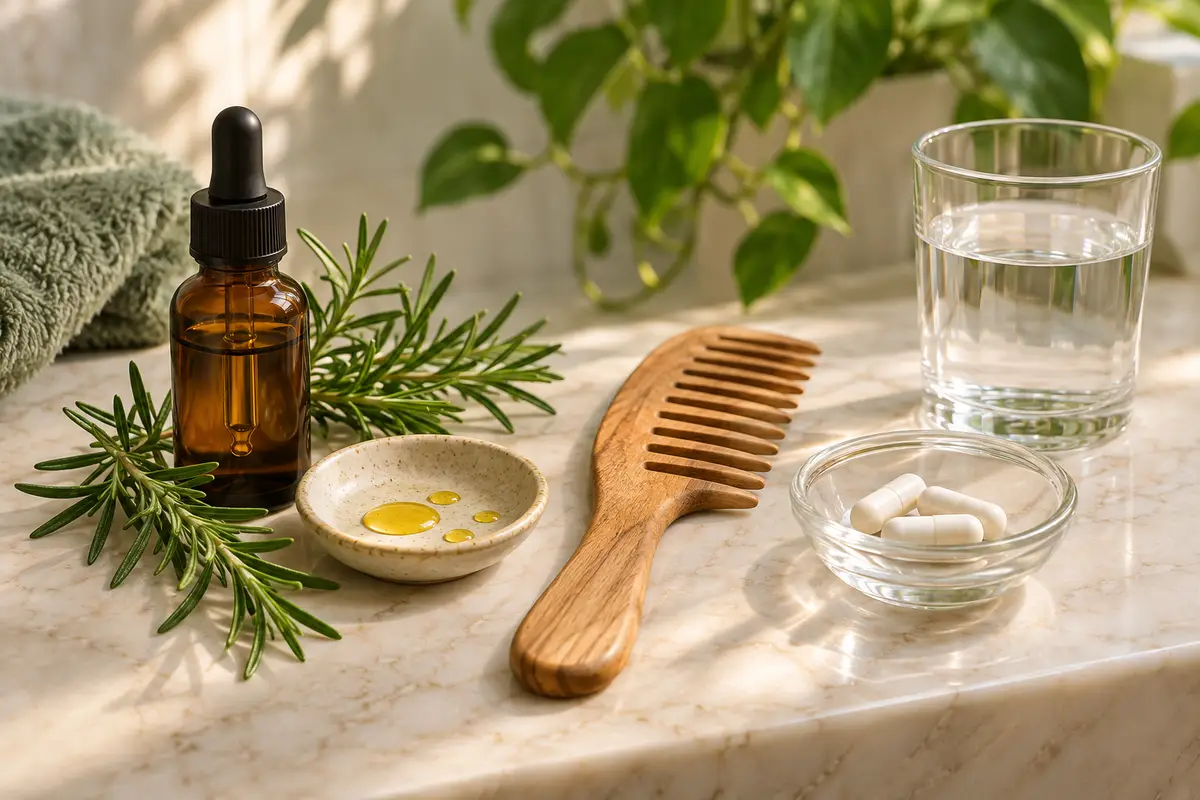
Rosemary oil went viral as the natural way to get thicker hair, and hair vitamins fill entire shelves. If you are deciding where to put your time and money, the good news is that you do not have to pick a side. They work in different ways, and knowing how each one works makes the choice easy.
Quick summary
Rosemary oil is a topical scalp treatment: massaged in, left on, washed out, a few times a week. Hair vitamins work from the inside by supplying biotin, zinc, vitamin C and B vitamins every day. The oil asks for more effort per use; the vitamins take seconds. For thinner-looking hair, the simplest strong routine is daily hair vitamins as the base, plus rosemary oil if you enjoy it.
How rosemary oil works
Rosemary essential oil is applied to the scalp, usually diluted in a carrier oil. Fans like it for the scalp massage itself, which feels good and gets you to pay attention to your scalp, and for its fresh, herbal scent. The interest took off thanks to one small study from 2015: 100 men with pattern hair loss used either rosemary oil or 2% minoxidil for six months. Hair counts went up in both groups by the six-month mark, with no significant difference between them, and the rosemary group reported less scalp itching. It is a single small trial, but it is the reason rosemary oil earned its place in so many routines.
What it asks of you: diluting the oil, massaging for several minutes, leaving it on for at least an hour (many people sleep in it), then washing it out. Done two or three times a week, that adds up.
How hair vitamins work
Hair supplements work from the opposite direction. Your follicles build each strand from keratin using protein, vitamins and minerals delivered by your blood. When daily intake is uneven, hair is one of the first places it shows. A good hair formula keeps the key nutrients topped up every day: biotin, zinc, vitamin C, niacin, B5, B6 and often horsetail for silica.
What it asks of you: swallowing a couple of capsules with a meal. Nothing to measure, nothing to wash out, nothing on your pillow.
Rosemary oil vs hair vitamins, side by side
| Rosemary oil | Hair vitamins (e.g. Rosedil) | |
|---|---|---|
| How it works | Topical, on the scalp | Nutrition from the inside |
| Time per use | 10–15 minutes plus wash-out | Under a minute |
| How often | 2–3 times a week | Once a day |
| Mess and scent | Oily hair until washed, strong herbal smell | None |
| Skin sensitivity | Must be diluted, patch-test first | No contact with the scalp |
| What it covers | The scalp environment | Biotin, zinc, vitamin C, B vitamins, horsetail |
| Timeline | Studied over 6 months | First checkpoint around 3 months, full picture ~6 |
| Easy to keep up? | Takes discipline on busy weeks | Very easy to make a habit |
Which one should you choose?
- Choose hair vitamins first if your diet is busy or uneven, you have noticed more shedding after a stressful stretch, or you want the lowest-effort routine you will keep for months.
- Add rosemary oil if you enjoy a scalp ritual, have time two or three evenings a week and your skin tolerates diluted essential oils.
- Use both if you want to cover your hair from the inside and the outside. They do not compete, and plenty of people find the combination keeps them motivated.
A simple combined routine
- Every morningTake your hair supplement with breakfast and a glass of water. This is the base of the routine.
- Two or three evenings a weekMassage a diluted rosemary hair oil into your scalp for a few minutes, then leave it on overnight or for at least an hour.
- On wash daysUse a gentle shampoo, focus it on the scalp and skip very hot water and high heat styling when you can.
- Once a monthTake a photo of your part and hairline in the same spot and light, so you can see progress over time.
Common mistakes with both
- Quitting too early. Both routines need months. Judge at three months, decide at six.
- Using undiluted essential oil. It can irritate the scalp; always mix it with a carrier oil or buy a ready-made blend.
- Doubling up on supplements. Stick to one hair formula at the dose on the label rather than stacking several products with the same nutrients.
- Ignoring sudden loss. Patchy or sudden hair loss is a reason to see a doctor, whatever routine you use.
Our recommendation: Rosedil
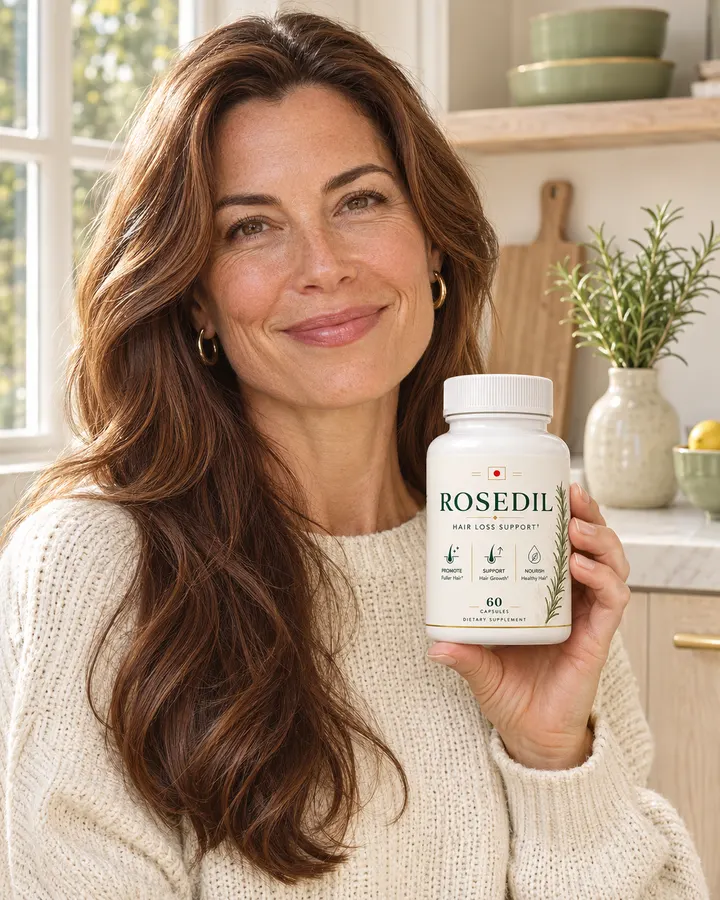
For the inside-out half of the routine, we recommend Rosedil. Its rosemary-sprig label fits right next to your rosemary oil, and its formula covers the nutrition side: biotin, vitamin C, niacin, B5, B6, zinc and horsetail in 2 capsules a day. It is the easiest habit in the whole routine to keep.
Two capsules a day give you 4,620 mcg of biotin, 157 mg of vitamin C, niacin, vitamins B5 and B6, 12 mg of zinc and horsetail extract, all listed on the label. It costs $49–$79 per bottle on the official website (free shipping on 3 and 6 bottles, one-time payment) and comes with a 60-day money-back guarantee.
Get Rosedil →Frequently asked questions
Is rosemary oil better than hair vitamins?
They do different jobs. Rosemary oil is a topical scalp treatment, while hair vitamins supply the nutrients your follicles use to build new hair. If you can only keep one habit, choose the one you will do every day for months; for many people that is the 2-capsule supplement, and those who enjoy a scalp massage add the oil too.
Can I use rosemary oil and take hair vitamins at the same time?
Yes. They do not compete with each other: one is applied to the scalp, the other is taken by mouth. A common routine is a daily supplement with breakfast and a rosemary oil scalp massage two or three evenings a week.
How do I use rosemary oil on my scalp?
Dilute it first, for example a few drops in a tablespoon of a carrier oil such as jojoba or argan, or use a ready-made rosemary hair oil. Massage into the scalp for a few minutes, leave it on for at least an hour or overnight, then wash out. Patch-test on your arm first, since undiluted essential oil can irritate skin.
Does Rosedil contain rosemary?
Rosedil has a rosemary sprig drawn on its label, and its formula is built from vitamins, minerals and horsetail: biotin, vitamin C, niacin, B5, B6, zinc, calcium and horsetail extract. That makes it a natural partner for a rosemary oil scalp routine.
How long do both take to work?
Both need patience. The rosemary oil study mentioned in this article measured results at six months, and hair vitamins usually need around three months for a first checkpoint and six for the full picture.
Sources
- Panahi Y, et al. Rosemary oil vs minoxidil 2% for the treatment of androgenetic alopecia: a randomized comparative trial. Skinmed, 2015;13(1):15–21.
- NIH Office of Dietary Supplements, Biotin fact sheet and Zinc fact sheet.
This article is general information, not medical advice. Dietary supplements are not intended to diagnose, treat, cure or prevent any disease. If your hair loss is sudden, patchy or comes with other symptoms, see a doctor or dermatologist.